Lake Ohrid conservation — why it matters and how we help
Lake Ohrid is a UNESCO World Heritage site with an ecosystem millions of years old. Here's why its protection is urgent, the threats it faces, and what we concretely do to preserve it for future generations.
Lake Ohrid is no ordinary lake. It is one of the oldest and most biologically rich lakes in the world — a living laboratory of evolution that has existed continuously for longer than our own species. Since 1979 it has been inscribed on the UNESCO World Heritage list for its natural values, and just a year later for its cultural ones. In 2019 the protection was extended to the Albanian side, so today the entire basin is recognised as shared heritage of both countries.
But heritage status, however important, does not protect the lake on its own. A UNESCO listing is a document — the lake is protected by the people who care for it on the ground every day. That is exactly why Amphibia exists: so that protection doesn’t stay on paper, but happens in the water, piece by piece. This article explains what makes the lake so valuable, which threats truly endanger it, and what we concretely do.
What makes the lake a global treasure
The age of Lake Ohrid was long a matter of estimates — figures of two to five million years are often cited. Today we also have a more precise answer. An international deep-drilling research project on the lake floor (known as SCOPSCO), involving 47 researchers from 13 countries, recovered a sediment core almost 570 metres below the bottom. The analysis, published in the journal Nature, showed that the lake formed about 1.36 million years ago and has existed continuously ever since — through ice ages, climate upheavals, and geological changes that destroyed countless other lakes. The tectonic basin itself is even older.
That uninterrupted stability, combined with isolation, produced something extraordinarily rare: over 200 endemic species — plants, fish, shellfish, shrimp, endemic freshwater sponges, flatworms, and snails that exist nowhere else on Earth. The most recognisable is the Ohrid trout (Salmo letnica), but the lake’s real treasures are the dozens of endemic snails and invertebrates, relicts of an ancient world that vanished elsewhere but survived here. It is no coincidence that UNESCO calls the lake a “museum of living fossils.”
The key to all of this is a single property of the water: the lake is oligotrophic — low in nutrients, rich in oxygen, and clear to great depths. It is a delicate balance that allows life to persist even tens of metres below the surface. And it is precisely that balance that is most vulnerable.
What we actually stand to lose
When we talk about conservation, it is easy to think of abstract “percentages” or “indicators.” But the stakes here are concrete and irreversible. An endemic species is one that lives in only one place on Earth. If it disappears from Lake Ohrid, it doesn’t relocate somewhere else — it is gone forever, from the planet. There is no backup population, nowhere for it to return from. That is why every harm to this ecosystem carries a weight far beyond the local: we lose a piece of the global natural heritage that evolved over a million years and more.
The same isolation that made the lake unique also makes it fragile. The species here have nowhere to flee and cope poorly with rapid change. So even seemingly small disturbances — a little more nutrients, slightly warmer water, a little more waste — can trigger effects that last for decades.
The threats the lake faces
The pressures on Lake Ohrid are real, cumulative, and mostly human in origin.
- Wastewater and eutrophication.This is the most serious long-term threat. Because much of the water comes from slow underground karst springs, pollutants neither dilute nor flush away quickly — they settle and accumulate. Inadequately treated wastewater and agricultural runoff introduce nutrients (nitrogen and phosphorus) that upset the oligotrophic balance. If this “feeding” of the lake continues, the risk of eutrophication grows — too much algae, less oxygen in the depths, and a direct threat to the endemic world.
- Solid waste on the lakebed. Glass, plastic, metal, and old fishing gear sink and gather on the bottom over the years, invisible to anyone looking from shore. Especially dangerous are so-called “ghost nets” — lost or discarded fishing nets that keep catching and killing fish long after they are abandoned, and that disrupt the spawning grounds of endemic species.
- Tourism and urbanization pressure. Uncontrolled shoreline construction, the seasonal influx of visitors, and increased traffic burden the basin and bring extra pollution precisely in the months when the lake is busiest.
- Climate change. Changes in water temperature and lake level affect the sensitive thermal structure and the endemic species adapted to narrow conditions — exactly the stability the lake has offered for a million years.
- Loss of shoreline habitats. The wetlands around the lake, such as Studenchishte Marsh, naturally filter the water and serve as spawning grounds and refuge for many species. Draining them and converting them to building or agricultural land reduces the lake’s ability to clean itself.
None of these threats is catastrophic on its own. The danger lies in their sum — they act at the same time and reinforce one another.
Why the lakebed is critical
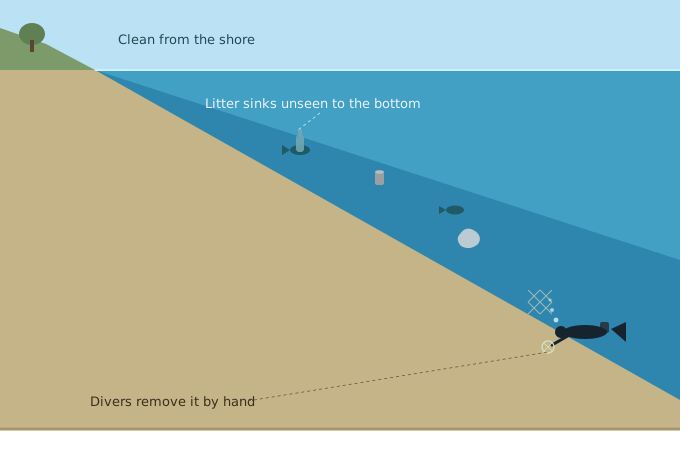
From the shore, Lake Ohrid looks flawless — clear, calm, clean. But much of the waste does not float on the surface; it sinks and ends up on the bottom, where it stays hidden and harmful for decades. There, conventional cleanup methods simply don’t reach: neither shoreline collection nor machinery can recover what lies ten, twenty, or thirty metres below the surface.
This is exactly where divers can make a difference no one else can. By diving and recovering waste by hand, piece by piece, from depths and tight spots no machine can reach, the waste is removed where it truly harms nature. At the same time, divers are the lake’s “eyes” below the surface — able to observe and document the state of the bottom in a way no report from the shore ever could.
How we help
As an association for ecology and water sports dedicated to nature, we don’t separate diving from conservation — to us they are one and the same. Every dive is a chance to observe, document, and care for this ecosystem. Our work moves in several directions:
- Underwater cleanups. We regularly organize actions to recover waste from the lake bottom, focusing on the locations where the most waste collects and where it harms nature the most, including the spawning grounds.
- Documentation and monitoring. We record where and what waste we find and the state of the underwater habitats. This data helps to understand the problem and to plan future actions where they are needed most.
- Raising public awareness.Much of the damage comes from not knowing — people don’t see the bottom, so they assume the lake is clean. By sharing what we find below the surface, we try to change that picture for both locals and visitors.
- Partnerships for proper waste handling. Our ecological actions are run together with partners who collect and properly treat the recovered waste — free of charge, as part of a shared commitment to a clean lake. That way the waste doesn’t return to nature but is recycled or disposed of responsibly.
- Responsible diving.Protection starts with the way we dive ourselves — without disturbing wildlife, without damaging the bottom, and with full respect for protected sites. If you’d like to dive with us, there’s more about the sites and conditions on our Lake Ohrid diving page.
Conservation is a shared responsibility
Caring for the lake is not the job of institutions alone, or of divers alone — it is part of every one of us. Fishermen, restaurateurs, local residents, visitors, and the authorities on both sides of the border share the same lake and the same responsibility. No single action will solve the problem on its own, but many small, consistent efforts together create real change.
If you’d like to join — as a volunteer on the shore, as a certified diver in the underwater actions, or by supporting an action — get in touch. We’ll let you know about the next action and how to take part.
What we inherit today, we leave to the next generations tomorrow. A lake with more than a million years of history deserves to be passed on at least as clean as we found it.
Frequently asked questions
Why is Lake Ohrid protected by UNESCO?+
Lake Ohrid was inscribed on the UNESCO World Heritage list in 1979 for its natural values and in 1980 for its cultural ones — a rare combination of both. The reasons are its age of over a million years, more than 200 endemic species, and continuous human settlement going back at least 7,000 years. In 2019 the protection was extended to the Albanian side, so today the whole basin is shared heritage of both countries.
What are the main threats to the lake?+
The main threats are wastewater and eutrophication, solid waste and 'ghost nets' on the bottom, tourism and shoreline urbanization pressure, climate change, and the loss of shoreline wetlands. Because the water comes from slow karst springs, pollutants don't dilute but accumulate, which makes the lake especially sensitive.
What is an endemic species and why does it matter?+
An endemic species is one that lives in only one place on Earth. Lake Ohrid has over 200 endemic species — fish, sponges, snails, and shrimp that exist nowhere else. If they disappear here, they're gone forever, which makes their protection globally important.
How do divers help protect the lake?+
Much of the waste ends up on the bottom, invisible from shore but harmful to underwater life. Divers can recover that waste by hand from depths and spots mechanical cleanup can't reach, and at the same time document the state of the ecosystem below the surface.
How can I get involved or volunteer?+
You can take part as a volunteer on the shore or as a certified diver in the underwater actions. Get in touch through our contact page and we'll let you know about the next action and how to join.
What happens to the collected waste?+
The collected waste is taken and properly treated by our partners, free of charge, as part of a shared commitment to a clean Lake Ohrid. That way the waste doesn't return to nature but is disposed of or recycled responsibly.