Why Lake Ohrid Is One of Europe's Oldest Lakes
Lake Ohrid is widely regarded as the oldest lake in Europe and one of the oldest in the world — a living relic that has held water continuously for over a million years. Here's why it's so old: geology, deep time, and the science that read its age from the mud on its floor.
Cradled in the mountains on the border between North Macedonia and Albania, Lake Ohrid looks, at first glance, like any other beautiful alpine lake: glassy water, a ring of peaks, a medieval town stacked along the shore. But beneath that calm surface lies one of the most remarkable bodies of water on the planet. Lake Ohrid is widely regarded as the oldest lake in Europe and one of the oldest in the world — a living relic that has held water continuously while ice ages came and went, mountains eroded, and entire species evolved within its depths.
The story of why it is so old is a story about geology, deep time, and a stroke of natural good fortune. It is also a story scientists have spent decades trying to read directly from the mud at the bottom of the lake.
What “old” actually means for a lake
Most lakes are surprisingly short-lived in geological terms. A typical lake fills in with sediment, silts up, and disappears within roughly 100,000 years. Rivers carry in mud and sand, organic matter settles, the basin shallows, and eventually a marsh becomes a meadow. On the geological clock, the overwhelming majority of lakes are blink-and-you-miss-it features.
Against that backdrop, a handful of so-called “ancient lakes” stand out — bodies of water that have survived for more than a million years. They are extraordinarily rare. Lake Baikal in Siberia and Lake Tanganyika in East Africa are the most famous. Lake Ohrid belongs in that exclusive club, and it is the only one of its kind in Europe.
So when we call Ohrid “old,” we don’t mean a few thousand years of human history (though it has plenty of that too). We mean that the lake itself — as a continuous aquatic ecosystem — has existed since long before modern humans walked the Earth.
How old is Lake Ohrid, really?
For a long time, the lake’s age was an educated guess. Older estimates ranged wildly, with figures of two to three million years commonly cited, and some sources stretching to as much as ten million. The uncertainty came down to a simple problem: nobody had read the full record. The only way to know how long a lake has existed is to drill into the layered sediment on its floor, which accumulates year after year like the pages of a book.
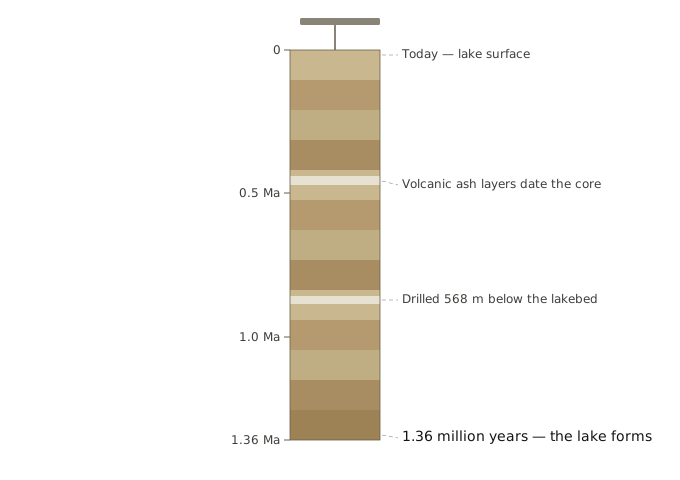
That changed in 2013, when an international team carried out one of the most ambitious lake-drilling campaigns ever attempted. Known as SCOPSCO— short for “Scientific Collaboration on Past Speciation Conditions in Lake Ohrid” — the project brought together 47 researchers from 13 nations under the umbrella of the International Continental Scientific Drilling Program. Led by geologist Bernd Wagner of the University of Cologne and Hendrik Vogel of the University of Bern, the team set up a drilling platform in the centre of the lake, where the water is around 245 metres deep, and bored down a further 568 metres into the sediment below the lake floor.
What they pulled up was astonishing: one of the longest and most complete lake sediment cores ever recovered anywhere, with more than 95 percent of the sequence intact. When the layers were dated using volcanic ash horizons and matched against known cycles in Earth’s orbit, the answer finally came into focus. The findings, published in the journal Nature in 2019, concluded that the lake formed about 1.36 million years ago and has existed continuously ever since.
That figure is worth dwelling on. It does not mean Ohrid is “only” 1.36 million years old in a dismissive sense — it means that for over a million years, through repeated glacial and interglacial swings, the lake never dried out, never froze solid to its bed, and never became salty. Geologists studying the basin itself have found evidence that sediment began collecting in the modern depression around two million years ago, so the structure that holds the lake is even older than the continuous water body it now contains. UNESCO and other heritage bodies still often describe the lake’s origins in the two-to-three-million-year range when accounting for the basin’s full tectonic history.
The geology that made it possible
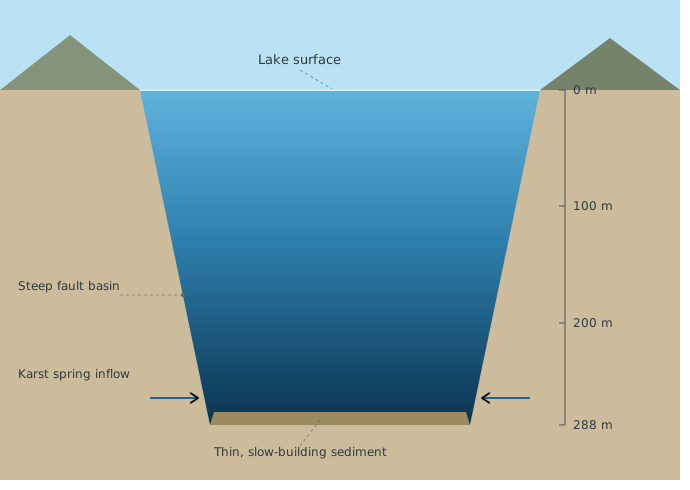
Ohrid owes its longevity to how it was born. It is a tectonic lake, formed not by a glacier or a river but by the slow pulling apart of the Earth’s crust. The Ohrid basin opened up as a graben — a block of land that dropped down between fault lines — during a long episode of crustal extension. This is the same mechanism that created the other ancient giants, Baikal and Tanganyika, and it is no coincidence that tectonic lakes dominate the list of the world’s oldest.
The reason is depth. A graben creates a steep, deep basin rather than a shallow pan. Lake Ohrid reaches a maximum depth of around 288 to 293 metres, making it the deepest lake in the Balkans. That depth is the single most important reason it has lasted so long. A deep basin takes vastly longer to fill with sediment than a shallow one, buying the lake hundreds of thousands of extra years before it could ever silt up.
A second piece of good fortune is where the water comes from. Ohrid is fed largely by underground karst springs rather than by big, muddy rivers. Much of its water travels underground from the neighbouring, higher Lake Prespa, filtering through cracks and channels in the limestone mountains before emerging crystal-clear into Ohrid. Because relatively little sediment is washed in from the surface, the lake stays deep and clear, and the natural silting-up process that kills ordinary lakes is dramatically slowed.
Finally, geography and a stable climate spared Ohrid the catastrophes that wipe out other ancient lakes. Throughout its long life it avoided complete desiccation, total glaciation, and salinisation — any one of which could have ended it. That uninterrupted continuity is precisely what the sediment cores confirmed.
A time capsule of climate history
Because Ohrid never dried out, the mud on its floor preserves an unbroken record of the regional environment stretching back over a million years. Each layer captures clues — pollen, algae, volcanic ash, chemical signatures — about the climate of the moment it was laid down. For climate scientists, this is the equivalent of an extraordinarily long, continuous diary.
The 2019 Naturestudy used this archive to reveal something genuinely surprising about Mediterranean weather. By analysing the cores, the researchers found that winter rainfall in the central Mediterranean has been linked, over the past 1.36 million years, to the rhythms of the African monsoon thousands of kilometres to the south. When summer sunlight intensified in the northern hemisphere, tropical climate systems shifted northward and Ohrid saw more winter rain. Few places on Earth could have told that story, because almost nowhere else holds such a long and uninterrupted sedimentary record. The lake is, in effect, a natural laboratory for understanding how the planet’s climate behaves over very long timescales.
A museum of living fossils
Old age, in a lake, breeds biological wonder. Because Ohrid has been a stable, isolated home for so long, life inside it has had over a million years to diverge into forms found nowhere else on Earth. The lake hosts well over a thousand recorded species, of which more than 200 are endemic— meaning they exist only here. By biodiversity measured against surface area, it ranks among the richest freshwater ecosystems anywhere in the world. UNESCO has fittingly nicknamed it a “museum of living fossils.”
The most celebrated resident is the Ohrid trout (Salmo letnica), an endemic species so distinctive that the lake was once known as “Trout Lake.” It is part of a small complex of closely related trout forms that breed at different times and in different places around the lake, keeping themselves reproductively separate. Alongside it swims the belvica (Salmo ohridanus), another endemic salmonid. But fish are only the headline act. The lake’s real evolutionary treasures are smaller and stranger: it is home to dozens of endemic freshwater snail species, along with unique sponges, flatworms, and crustaceans whose lineages trace back through deep time. Many of these creatures are relicts — survivors from an ancient world that vanished elsewhere but persisted in Ohrid’s clear, oxygen-rich, low-nutrient water. That same underwater world is what makes diving in Lake Ohrid so special.
That oligotrophic chemistry — low in nutrients, high in oxygen and clarity — is the foundation of the whole ecosystem. It allows life to thrive at remarkable depths and supports a food web found nowhere else. It is also exactly what makes the lake so vulnerable.
Old, but fragile
For all its resilience over geological time, Lake Ohrid faces threats that operate on a human timescale of mere decades. Uncoordinated urban development along the shore, inadequate wastewater treatment, agricultural runoff, and intense tourism pressure are pushing nutrients into a system that has stayed pristine for over a million years. Even a modest rise in nutrients risks tipping the lake out of its delicate oligotrophic balance, which would endanger the very endemic species that make it special. Pollution, illegal fishing, and abandoned “ghost” fishing nets that smother spawning grounds add to the strain. The irony is sharp: a lake that survived ice ages and a million years of climate upheaval is now most threatened by the people who live and holiday around it.
This is why the Ohrid region’s dual UNESCO World Heritage status — listed for its natural values in 1979 and its cultural values the following year — matters so much, and why the lake is also protected as a Ramsar wetland site. These designations recognise that Ohrid is not just a scenic backdrop but an irreplaceable natural archive and an ecosystem with no substitute on the continent. Protecting that ecosystem is the reason we exist — through our ecological actions and underwater cleanups.
Why it deserves our attention
Lake Ohrid earns its title as one of Europe’s oldest lakes through a rare combination of circumstances: a deep tectonic basin, clean spring-fed water, low sediment input, and the simple luck of avoiding catastrophe for well over a million years. The sediment cores drilled from its floor have transformed a long-standing guess into hard scientific fact — and in doing so revealed a climate record of global importance and a wellspring of life found nowhere else.
To stand on the shore at Ohrid is to look out over deep time itself. The water in front of you has been there, more or less continuously, since long before our species existed. Few places on Earth offer such a direct line back to the ancient past — and even fewer make that past feel so alive. If you’d like to help keep it that way, get in touch.
A million years in one lake — a legacy we protect together.
Frequently asked questions
How old is Lake Ohrid?+
The 2013 sediment-drilling project (SCOPSCO) and the study published in Nature in 2019 showed that the lake formed about 1.36 million years ago and has existed continuously ever since. The tectonic basin itself is even older — sediment began collecting around two million years ago, which is why a range of two to three million years is often cited.
Is Lake Ohrid the oldest lake in Europe?+
Yes. Lake Ohrid is widely regarded as the oldest lake in Europe and the continent's only true 'ancient lake' — a body of water that has survived for more than a million years. Globally it belongs to the same exclusive club as Lake Baikal and Lake Tanganyika.
What is the oldest lake in the world?+
The oldest lake on Earth is generally considered to be Lake Baikal in Siberia, around 25–30 million years old. Lake Ohrid is younger but still among the world's oldest, and far older than almost all other lakes, which are typically only 10,000 to 100,000 years old.
Why has Lake Ohrid survived so long?+
Three factors: a deep tectonic basin (up to ~288–293 m) that takes hundreds of thousands of years to fill with sediment; water fed by clean underground karst springs rather than muddy rivers, which brings in little sediment; and a stable climate that spared it from complete desiccation, glaciation, or salinisation for over a million years.
How do scientists know the lake's age?+
By drilling into the layered sediment on the lake floor, which accumulates year after year. In 2013 the international SCOPSCO team drilled 568 metres into the sediment and recovered one of the most complete lake cores ever taken. The layers were dated using volcanic ash and orbital cycles, with the results published in Nature in 2019.
Why is such an old lake so fragile?+
Because its ecosystem depends on an oligotrophic balance — water low in nutrients and high in oxygen and clarity. Even a modest rise in nutrients from wastewater, agriculture, or tourism can upset that balance and endanger the endemic species that survived for a million years. Pollution and abandoned fishing nets add further strain.